

The prices of plots and building materials have skyrocketed in recent years in Spain. At the same time, larger and larger projects are being built with ever higher margins. Most analysts realize that this risks building mini-bubbles in the market, and that many projects that for sale will never even be completed as they will not sell enough apartments/houses to break even for the promoter (builder) who finances the individual project. This problem has only gotten worse with inflation and interest rate increases.
In addition, in these construction projects, transparency and security for buyers are substandard. This development worries many, not least the major Spanish banks that are responsible for security. However, there is a way forward that will take Spain out of this dilemma, and this way is found in a working model that was successful in the past.
Housing Cooperative are cheaper and significantly safer for the buyer
The solution is so-called housing cooperative that not only pushes down prices but also increases safety for both the individual buyer and the bank.
The above lines are already and will become even more relevant in the wake of the Corona and inflation crisis. Many of the giant projects that are now for sale in Spain will simply not happen. Smaller projects, where the buyers, as a group, instead of a promoter, buy up the land and build, are the only way forward.
When reading the Swedish newspapers, it is easy to get the impression that everything is delayed and that everything has become more expensive, etc. This is not a general truth. Our project Colina de Alta in Nerja, for example, construction began in Q1 2022 and was about 3 months ahead of schedule during the fall and it has continued to roll on. Although some materials have become more expensive, other materials have become cheaper. Prices can still go up slightly of course, but as it looks now, the prices of materials and deliveries will normalize. This construction community had really good prices when we launched it and the situation as you can see in the picture from the construction is excellent! Finally, we would like to add that we are very satisfied with the construction company and they will definitely be commissioned to build more of our upcoming projects.
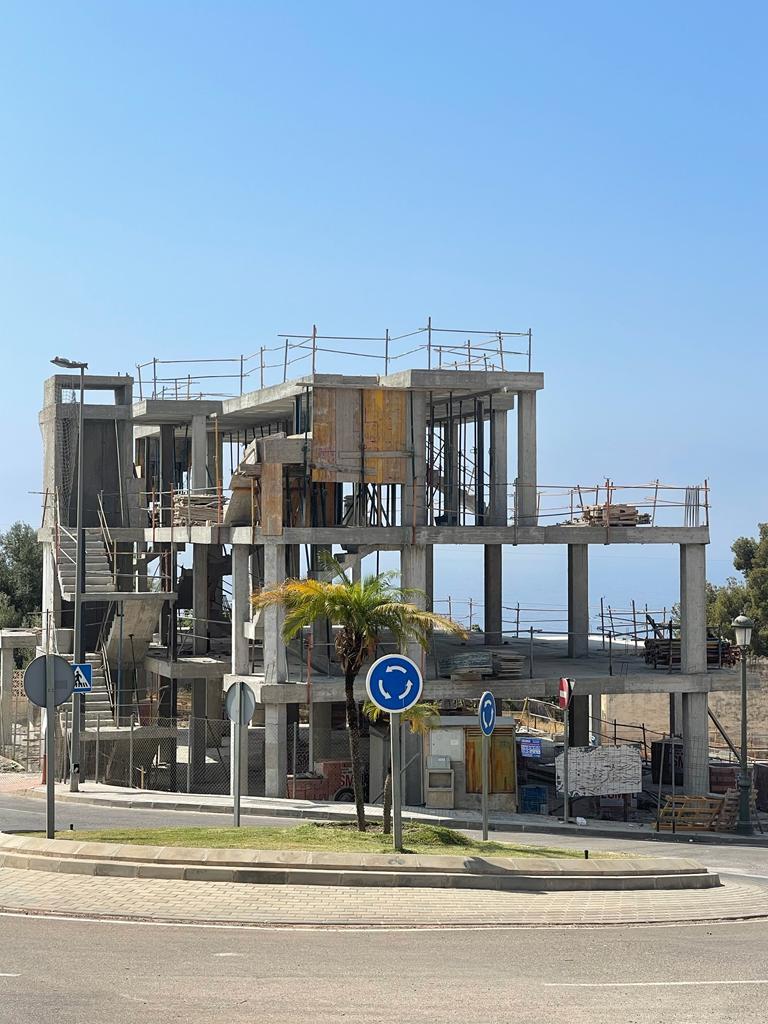
The value of attractive, turnkey new development will, with high probability, rise enormously in the first half (starting from the second half of 2024) of the 2020s. Especially in areas like Malaga and Nerja and the surrounding area where there was already a shortage of new development before Corona. As the appetite for new development has increased (prices rose by 10% in July 2021 alone), it remains to be seen whether the market can resolve all the hurdles that have arisen and deliver new development faster than expected after all.
In this article we explain why housing cooperative model is on the rise again in Spain (but also in Sweden, and not least in Germany and other countries) and why you should also consider investing in an apartment or house in a housing cooperative in Spain – as the security for you is much higher, and prices up to 25% lower (but even lower according to the actual figures we have in winter 23, from various projects. There has been less construction than expected in recent years, while demand for turnkey new development is greater than in many years, which drives up prices further upon completion). housing cooperative model is also for several reasons, in addition to the depressed prices, more attractive to the investor. More about the safety and other advantages of this model below. Further down in the article you will also find all projects that are for sale here and now, and that are underway during the yearLet's first define this cost-effective construction concept.
Please note that prices are usually so much lower per square meter for a housing cooperative that Spanish law aims to prevent speculation. According to the Spanish law that regulates this project solution, each individual (this law also applies to companies) is thus entitled to buy a maximum of 2 homes in a housing cooperative per autonomous region. However, it should be noted that once the homes are completed (and housing cooperative is dissolved and they legally become ordinary condominiums), you can buy in additional communities if you wish. The reason for this law is that housing cooperative are cheaper than promotions and the aim is to prevent individual investors from concentrating on a single area, buying up several properties and distorting prices through high rents or pure speculation.
Spanish banks are increasingly rejecting the current promoter model and believe that housing cooperative are a safer form of construction for all parties. However, it is a legally complicated process to pilot this type of project through all the tightly regulated bodies and it will take a long time before this concept is widely available again. Most commonly right now it is in the competitive market in Madrid where increasingly high land prices have caused banks to pull the brakes on costly construction promotions. With the Great Recession from the first decade of the 2000s fresh in their minds, banks now again want to see projects where the financing (including financial review of each individual buyer) is more secured.

What is a housing cooperative ?
What is housing cooperative and why invest in this model instead of a regular promotion model?
Housing Cooperative .se has the following definition of the model:
“The driving forces for wanting to be part of a housing cooperative can vary. It can be about wanting to live together, about the design of the home, about ecological construction, about how you want to live as an elderly person – or about wanting to keep the profits from building in attractive locations yourself.
For society housing cooperative are a way to achieve more interesting and varied urban development. Experiences from Germany show higher quality, more interesting architecture, greater diversity and a deeper commitment to one's own housing. Disadvantages can be that conflicting wills make the process more difficult, while also requiring efforts of patience and money over a long period of time before the reward comes.”
A housing cooperative (i.e. Baugemeinschaft) is simply an association of individuals who jointly buy up a plot of land , plan and have one or more buildings built.
Housing Cooperative can then use different forms of tenure in the completed property, such as tenant-ownership, cooperative tenancy, ownership or tenancy. The association usually has a special focus for the housing, such as environmentally friendly or child-friendly housing, etc. Our focus is to find the best possible investment for both rental and value increase . We find plots in attractive locations with an attractive price picture, and build at the lowest possible cost without compromising on quality. We then offer a comprehensive concept for renting out the homes, which includes caretaker management, key management, license management and marketing in international portals for maximum occupancy rate . Already in the planning stage, we have investors with whom we play ball when it comes to the design of the buildings. However, there is no requirement that the buyers in our housing cooperative join in order to invest. Approximately 50% of the buyers are de facto families with children who want large homes in safe locations, close to the airport and sea, etc. For them, the rental potential and value increase are a pure bonus, and not the primary purpose of the purchase.
NOTE that when the construction is finished [in Spanish housing cooperative ] the community is dissolved and the apartments are legally considered as ordinary owner-occupied apartments again. It is therefore no difference whatsoever owning an apartment purchased through a housing cooperative compared to any other promotion model in Spain. A Spanish housing cooperative is simply a cost-effective and safe way to build homes.
In Sweden and Germany it is common for all owners to be involved from the beginning and design the accommodation, but this is not the case in Spanish housing cooperative . There the main purpose of pushing down prices compared to a promoter model. Letting 10 different nationalities participate in the basic process would slow down the entire construction process too much. In addition, there are strict Spanish building codes and detailed plans to work with. In Spain, it is also more about the location (preferably elevated , near the sea, near the airport) than about the design of the accommodation itself.
However, plots prices are skyrocketing, so a wide network is required to find the remaining and suitably sized plots , in good locations that for sale at reasonable prices, in order to be able to build an attractive and affordable product. That is to find these plots that is our main task. In addition, our strategy is to mainly sell to Scandinavian buyers, which simplifies the entire process as most people (for example, Scandinavians do not want to limit the ability to rent out their home) have the same opinion about the design of the community, as well as the housing association's rules, etc.
The association has no debts after move-in
Also note that in Sweden the housing association is often in debt, which affects the rents for the condominiums in the association. This is not the case in Spain, as in Spain there are generally no loans in the associations. Even though Spanish housing associations do not have any debt, there are still area fees (the amount varies, ranging from €500 per year to €2200 per year) once a year for the maintenance of the property, pool, lighting, green areas, etc.
All payments in a housing cooperative are made during the construction process and finance it step by step (they are also secured by an external insurance company that guarantees that you will get back the money you deposited plus interest in the event that something unforeseen happens during the construction process). All payments to external parties are made via the bank's separate account for the project according to a strictly regulated payment schedule. Commissions to the project's architects, brokers, project managers, auditors, etc. are also paid via the bank that has been commissioned by housing cooperative to manage the construction's finances.
Housing Cooperative appeals to investors who want to see high Return on Investment
The Swedish National Board of Housing, Building and Planning defines a related concept: “The concept of housing cooperative also occurs and can be synonymous with housing cooperative , but can also mean that one or more of the members of the group will not live in the house themselves but participate as long-term investors and see the co-ownership in the finished house as a capital investment.”
Approximately 50% of our buyers belong to this particular group of buyers, i.e. investors who invest for income through both rental and value increase in the long or short term ( the price of an apartment increases significantly on an off-plan apartment in Spain already upon move-in ). In a strict sense, we are therefore marketing “ Housing Cooperative ” since several Scandinavian buyers, whom we primarily target with these projects, are pure investors.
We thus offer, as previously mentioned, a comprehensive concept with a separate company for rental, and we help with the process of obtaining a license for rental, etc. A very important aspect in this context is also that We include in the association's statutes, right from the start, that it will be allowed in the future to rent out your home to anyone who wishes. Once you have received your rental license, this cannot be retroactively revoked according to the law. We do this in this way due to the new law that means that housing associations throughout Malagaprovince can prohibit or restrict rental for tourist purposes by putting it up for vote at an association meeting. It is enough for three-fifths of the owners in a housing association to vote in favor of the ban for it to apply. This also includes new projects with new development , where in many cases the possibility of renting out to tourists is prohibited from the outset. However, the newly produced apartments that allow rentals are pure hard currency in markets such as Malaga city, Nerja and Marbella where demand is enormous.
spanskafastigheter.se and our history and future with Spanish housing cooperative
Our corporate lawyer, Francisco López, whose father used the housing cooperative project model successfully in Malagaprovince several decades ago, realized even before the new development really took off after the crisis that in order to sell a project within a reasonable time, prices had to be pushed down without compromising on quality. He therefore took up the housing cooperative concept again, and found financiers for a plot of land in an attractive location in the popular resort Nerja. We sold that project, Ladera Terrazas in record time.

We then launched another housing cooperative (Balcon del Mar) in the same area, Ladera del Mar in Nerja, the following year. That project also sold out quickly due to the competitive prices.

Already in the planning stage of our previous housing cooperative , there was great interest among banks etc. and we made important contacts. The housing cooperative model appeals mainly to banks because it is a safer way, for everyone involved, to plan and build on. The prices are lower and the transparency is better, and the tightly regulated model, with an independent auditor, special bank accounts set up by the bank that handle all payments to subcontractors as well as brokers and project managers etc., and an insurance company that guarantees all money deposited by buyers, is significantly safer. The banks' national risk departments also have greater ability to regulate this type of project. For example, each individual buyer approved by the bank, regardless of whether he applies for a loan or not.
The big challenge has been finding employees who are familiar with how to actually comply with all the laws and regulations that apply to this type of construction. That's where our team and basically only one other major player on Costa del Sol knows this working model.
Together we scan Costa del Sol for attractive plots in both central locations in growing Malaga and plots on the beaches in the surrounding coastal towns. We then design houses/apartments, and form housing cooperative that we market mainly to Scandinavians. Through our international partner, we also rent out the homes to an international market. However, this concept is something that international investors are also interested in. We will therefore not limit ourselves to the relatively limited Scandinavian market in the long term.
Our latest housing cooperative
Sold / under construction below:
18 townhouses near the beach in Punta Lara Nerja
Large roof terraces. Equipped kitchens. Community pool and nice meeting areas in the area. South facing . 2-3 bedrooms. [note, sold and under construction, but write to info@spanskafastigheter.se if you want to be in line, in case someone comes back) Read more here.

8 apartments in elevated location in Nerja- Colina Alta
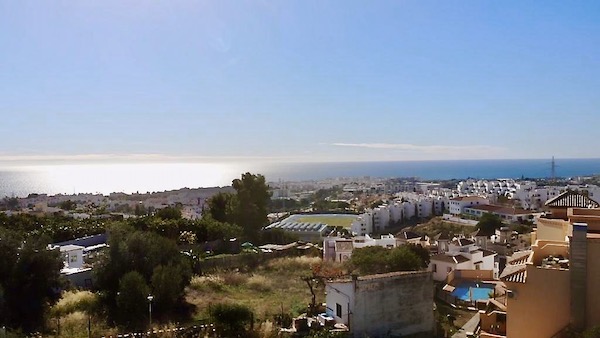
Colina Alta in Nerja
After the turn of the year 21 we launched 8 off-plan apartments in Nerja. Elevated location with sea view . Afternoon sun. Smaller urbanization in a quiet location, within walking distance to town center and beach , with both pool and garage. Renegotiated and market prices on the land have given us the opportunity to offer these apartments at fantastic prices. 2 bedrooms, terrace, from under €200,000. Under €350,000 for duplex with 2 bedrooms and 3 bathrooms. Read more about Colina Alta here. These are sold but some may come up for sale after completion. If you want to be on the waiting list, write to info@spanskafastigheter.se
We always launch our projects (but also regular promotions we get sales rights for, to the extent possible) with housing cooperative in advance to our newsletter followers.
- Sign up for the newsletter for Nerja, Torrox and Costa Tropical here (as well as Malaga city).
- Sign up for the newsletter for Marbella, Estepona, Benalmadena, Torremolinos and all other resorts on the western Costa del Sol (as well as Malaga city) here.
- Please also write directly to info@spanskafastigheter.se
Housing Cooperative is in the planning stage in 2024:

Nerja
At the time of writing, we are negotiating prices with landowners, while also bringing in financiers to secure land.
Conclusion and summary
The profit margin for a traditional promotion model, which is customary in the Spanish housing market, is significantly higher. Lower commissions etc. for everyone involved in a housing cooperative means lower final prices of around 25%. In addition, the working model means greater transparency and co-determination for buyers. The board is elected by all members who also have voting rights in several important issues during the construction process. The board is continuously informed by the project management and independent auditor about everything that happens in the construction, and makes certain decisions on behalf of the members. However, certain decisions must be voted on by each individual member. Everything is regulated by the Spanish laws that specifically apply to housing cooperative and all payments of commissions to brokers, project managers, subcontractors/builders, etc. are handled by the bank via a specially established bank account that only the bank has access to. An insurance company guarantees all payments by buyers during the construction process.
In broad terms, This is how housing cooperative process works in Spain:
1. The project management identifies a suitable plot of land (lawyer checks the detailed plan of the plot , that it is suitable for a housing cooperative ) for sale and initiates negotiations with plot of land owner. The Plot is tied up for a certain period of time.
2. Then a housing cooperative is registered, and an account is created in a bank that also provides bank financing for the construction, while a plan for the construction is made by the architects.
3. Reservations for the homes begin to be collected and a building permit is requested from the municipality at the same time.
4. When all the homes are sold , a board of directors is formed for housing cooperative . All buyers are invited to a board meeting, where, among other things, a chairman is elected.
5. The construction company is selected by the board in consultation with project management after a quotation process.
6. The land is purchased by housing cooperative and then construction begins.
7. When it is completed, title deeds are written to each individual owner and housing cooperative is dissolved. Each apartment is now considered by law to be any owner-occupied apartment. The same applies to the housing association for the complex itself. It is also important to point out that this economic owners’ association does not have a loan with joint and several liability for payment after completion. Association fees (to be considered as rent) are therefore not affected by a possible increase in interest rates as there are no debts in the association.
⁃ The two most fundamental aspects of housing cooperative working model in its Spanish design:
- Lower prices when you remove the promoter from the equation (this does mean that both we and others involved in the project receive significantly lower commissions than usual, and that we have to wait for these until it is completed, but it also means that we get a much easier-to-sell product). Regular building promoters are simply not willing to cut into the profit margins in the same way that a housing cooperative does. Depending on the complexity and volume of the project, the margins for a regular building promotion are at least 15% and up to 25%. The project management fees for a housing cooperative are 7-12% (read more in Spanish article about Spanish housing cooperative in Madrid here).
- Stronger financial and legal security with increased transparency as everything is strictly regulated by Spanish laws (independent auditor, higher transparency and co-determination of owners, etc.) and the board actively participates in all decisions.
More reading:
- Everything you need to know about investing in Spain
- The area and projects that are primarily recommended for investment in 2024-2025
- Frequently asked questions and answers about buying a home in Spain
- About taking out a loan in a Spanish bank
- Overview new development Costa del Sol
- Guide to Malaga
- Guide to Nerja
- Guide to Marbella
- Guide to Costa del Sol
- About page spanskafastigheter.se