
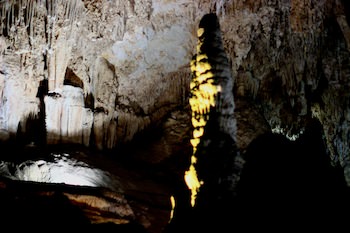
Five young boys in the village Maro, right next to Nerja, on the eastern Costa Del Sol used to enjoy looking for holes in the ground where they had seen bats hiding. On the evening of January 11, 1959, they were out hunting with their flashlights and saw a large number of bats flying out of the ground. The next day, they returned with tools to knock away the stalactites (icicle-like formations) that were hiding the entrance to what appeared to be an exciting and large cave.
A new study (2023) led by the University of Cordoba shows that the history of the Nerja Cave can be reconstructed using fossilized soot and charcoal from torches that are more than 8,000 years old. New traces take the history of the cave in Nerja back further than previously thought. Together, the researchers show that humanity has lived in Nerja for around 41,000 years, 10,000 years longer than previously thought – and that the European cave with Paleolithic art has experienced the most confirmed and frequent visits in ancient history. This latest work also presents 68 dates, 48 completely new, from the lowest parts of the cave, where Paleolithic art and evidence of chronocultures that have never been documented before have been discovered. “The prehistoric paintings were viewed in the flickering light of the flames, which could give the figures a certain sense of movement and warmth,” explains Medina, who highlights the funerary use of the Nerja Cave during the latter part of antiquity for thousands of years. “There is still a lot it can reveal about what we were like,” she says.
Descending into the Nerja Caves is like descending into a prehistoric and magical world
What the boys saw when they descended into the underworld was a secret that had been kept for over 5,000 years and can be better described as a scene from a Steven Spielberg movie than reality. With open mouths and wide eyes, they shone their flashlights and stepped in large puddles of bat shit, making their way through the surreal, gigantic cave landscape until they finally came across large piles of skeletons.... They then panicked because they thought they were former adventurers who had gotten lost in the enormous corridors.


It later turned out that the skeletons were bodies several thousand years old, as the cave was, among other things, a burial place for Stone Age people. Cave paintings and other archaeological finds show that people had lived here for over 27,000 years ago (new finds, however, push these figures back more than 10,000 years!)However, in connection with an earthquake, the entrance to the cave collapsed and the Cueva de Nerja, as the caves are now called, was relegated to the list of unknown wonders of the world.
In addition to historical cave paintings, tools and skeletons, the caves have uncovered the world's largest stalactite formation. It is 32 meters high! The caves are 35,484 square meters in size (making it one of the world's largest of its kind) and here you will find indescribable formations of stalactites and stalagmites that many consider to be among the world's absolutely most beautiful. The caves are still being explored so the entire area is not open to the public.
The formations appear to be human art. Many visitors even believe that the caves of Nerja are some kind of “art installation” by the Arabs who ruled here hundreds of years ago. The Arabs were certainly skilled craftsmen and artists, but it has taken unimaginable toll on Mother Earth five million years to form the stalactites and stalagmites and arrange them together into a work of art a human artist cannot even dream of coming close to creating.
The acoustics are phenomenal and they host a famous music festival every year (Festival de la Cueva is always held in the last two weeks of July). People also gather in their thousands outside the caves to barbecue and drink sangria all night long during the San Isidro festival in May.
In early summer 2015, the new botanical garden in the area. It is home to over 200 different species of animals, 42 of which are endangered.
Do you want one? nice and affordable accommodation In connection with the caves we recommend that you rent something in Nerja, the mountain village Frigiliana or Maro.
By the way, our favorite area is in Nerja, Capistrano Village, under 10 minutes drive from the caves.
Short video with images from the caves in Nerja:
Facts about the Caves of Nerja:
Cameras are allowed but you are not allowed to use a flash. However, a good camera and steady hands will go a long way as light sources have been placed here and there along the paths.
Opening hours for the Nerja Caves
The caves are open year-round with the exception of January 1 and May 15.
Opening hours July-August: 10-19:30 (however, it closes an hour earlier during festival week).
Remaining months: 10-14, 16-18:30.
Tip: go there in the off-season just before closing time, then you have the opportunity to basically walk around certain stretches by yourself, which feels strangely peaceful.