
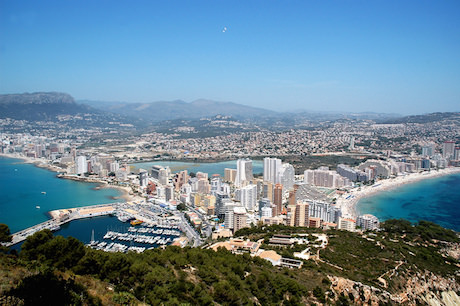
The town of Calpe, or Calp in Valencian, is located on the coastal strip Costa Blanca just north of AlicanteThe town is primarily a holiday resort and tourism is clearly the most important industry. Calpe has a permanent population of around 30,000 inhabitants, but during the summer it doubles several times.
Entertainment Calpe
Calpe has a nightlife that is geared towards catering to tourism. This means that the city may not have the most authentic nightlife, but of course there are every opportunity to go on a bar crawl for tapas and a glass of cava or two.
The nightlife is centered around the streets Pintor Sorolla/Blasco Ibanez, but there is also a wider selection of restaurants and bars around the port and La Fossa-Levante beach.
The city is famous for its fiestas, and it hosts several festivals every year. Some examples are the Christmas celebration when the three kings arrive, the "battle" between the Moors and the Christians, and the German Oktoberfest (!).
Attractions Calpe
Calpe's historical attractions may not be numerous, but they are certainly interesting. Two highlights are Els banys de la Reina (The Queen's Baths) and the La Peça Tower.
Birdwatchers will find a bit of a paradise in Calpe. The salt flats just east of the town centre and north of the Penyal d'Ifach cliff are home to a variety of unique migratory birds.
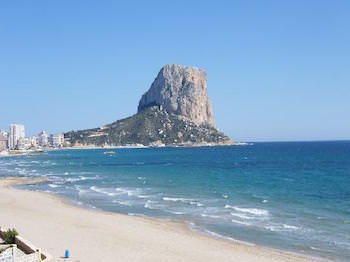
The Penyal d'Ifach rock is perhaps the biggest attraction of all categories. The rock, which measures 332 meters above sea level, is an impressive sight on the coastline. Historically, it has actually been considered a twin to the rock of GibraltarThe view is of course fantastic from the top, but you should be prepared for the climb to be a bit difficult.
History of Calpe
The history of Calpe begins, like most other towns along the Spanish Mediterranean coast, with a visit from the Iberians. Then came the Moors who ruled until 1290 when the Kingdom of Aragon took over the city. Since then, Calpe has been part of the Spanish central power.
In the early 19th century, fishing tourism began to gain momentum and fishing has been an important industry ever since. However, during the 1950s, fishing was overtaken by tourism.